
Human-Robot Interaction in Social Robotics
The aim of the project, funded by the European Regional Development Fund, is to establish an interdisciplinary testing and experimentation environment for social robots.
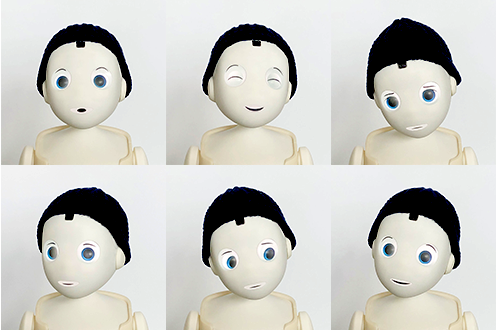
- Rou Sommermann
- Anna Gasviani

The Potsdam University of Applied Sciences is currently establishing an interdisciplinary testing and experimentation environment for social robots. The aim is to investigate technological, design, methodological, and ethical questions in the development of AI-based robot systems that collaborate with humans in everyday contexts and environments, from various perspectives and for specific application areas. The robot systems (including navel, Furhat, and Misty II) each include comprehensive SDKs (Software Development Kits) and enable flexible prototyping and testing of new application scenarios for social robots.
With the Social Robotics Lab, the university aims to open up the innovative field of "Artificial Intelligence for Social Robot Interactions" to Brandenburg universities and interested cooperation partners from research and technology transfer in the region, making it tangible in real-world laboratories. The lab is being established at a time when the spectacular breakthrough of AI-based chatbots and speech models has raised context-related communication between humans and machines to a new level. With the advancement of artificial intelligence, more and more AI-enabled robots are being deployed for human-robot interaction to perform a wide variety of tasks. Combined with the rapid development of sensors for increasingly detailed speech, gesture, and emotion recognition, powerful 3D lidar sensors for high-resolution environmental perception, and miniaturized actuators as the basis for the robots' fine motor movements, new application scenarios for social human-robot interactions are emerging, particularly in conjunction with AI-based conversational AI chatbots.
The challenge lies in the fact that social interactions are complex processes in which a multitude of psychological, sociological, and other factors interact. The Potsdam University of Applied Sciences (FH Potsdam) aims to contribute to the question of how human-robot interactions in social situations can be improved through its interdisciplinary research profile at the intersection of social and educational sciences, interface and product design, and media and information sciences. Furthermore, it seeks to explore how robots can learn to cooperate with humans in a socially and ethically appropriate, fair, and non-discriminatory manner. Ultimately, this involves answering the question of whether areas such as education, care, health, and entertainment truly benefit from machines that use sensors and artificial intelligence to establish empathetic interactions with humans. If social robots become our pets, caregivers, or learning companions, we must determine the technological, social, and ethical possibilities and limitations of their use. Under what conditions can robots become companions, and what ethical problems might arise in such a human-robot relationship?
Ultimately, this research addresses the question of whether fields such as education, care, health, and entertainment truly benefit from machines that use sensors and artificial intelligence to establish empathetic interactions with humans. We consider social robots to be socio-technical systems (STS), whose design and use can only succeed if the mutual influence of social systems (people, professional and age groups, etc.) and technical systems (e.g., robots) and their relationship to each other are holistically the focus of research and development work.